Make sure to check out the rest of Jegang's "Arkham" gallery, too.

Showing posts with label Two-Face. Show all posts
Showing posts with label Two-Face. Show all posts
Thursday, January 26, 2012
Two Face by Jegang
I love the graphic design elements in this work of art:
Make sure to check out the rest of Jegang's "Arkham" gallery, too.
Make sure to check out the rest of Jegang's "Arkham" gallery, too.

Tuesday, October 19, 2010
75 Favorite Moments in DC History: Number 49
49. Justice is served, Harvey Dent style (Batman: Shadow of the Bat #62-63, 1997.) (***Potential Spoilers!***
I know hardly anything about The Punisher, but the more I think about it, the more I think I'd like him. Sometimes I need a break from the peaceful-warrior style of Justice served by heroes like The Martian Manhuner, and I need a Machiavellian approach to satisfy those darker yearnings for Revenge...er...Justice. (Did I mention I'm half-Sicilian?)

There's a book I have called Batman and Philosophy in which one of the essays examines whether Batman's decision to not kill the Joker is causing more lives to be lost. Depending on the mood I'm in, I'll waver between, "Don't sacrifice your morals and break your one rule!" to "Oh, just kill him already and be done with it!" But Bruce Wayne won't ever pull a trigger, even in the name of Justice.
But guess who will?

Yeah, that's right, Batman: Harvey Dent will get your dirty work done. Good thing about leaving things to the Fate of a coin toss: it's really good at absolving guilt. The good portion of Harvey's psyche decices to emerge and punish criminals under the mantle of "Janus." He's pretty darn close to being a superhero, too: he dons a mask of the Greek god Janus and some black robes and starts punishing criminals and righting wrongs, and even twarts Two-Face's plans to destroy the city, becoming his own nemesis. I could get used to this.
Plus, as an added bonus, we get to see Harvey Dent in a naval uniform and speak all piratey and shoot people with a gun that makes really cool sound effects:


I know hardly anything about The Punisher, but the more I think about it, the more I think I'd like him. Sometimes I need a break from the peaceful-warrior style of Justice served by heroes like The Martian Manhuner, and I need a Machiavellian approach to satisfy those darker yearnings for Revenge...er...Justice. (Did I mention I'm half-Sicilian?)
Fun Fact: My Mom's dog is a Chow Chow!
There's a book I have called Batman and Philosophy in which one of the essays examines whether Batman's decision to not kill the Joker is causing more lives to be lost. Depending on the mood I'm in, I'll waver between, "Don't sacrifice your morals and break your one rule!" to "Oh, just kill him already and be done with it!" But Bruce Wayne won't ever pull a trigger, even in the name of Justice.
But guess who will?
All Batman villians must laugh when shooting their henchmen. It's just tradition at this point.
Yeah, that's right, Batman: Harvey Dent will get your dirty work done. Good thing about leaving things to the Fate of a coin toss: it's really good at absolving guilt. The good portion of Harvey's psyche decices to emerge and punish criminals under the mantle of "Janus." He's pretty darn close to being a superhero, too: he dons a mask of the Greek god Janus and some black robes and starts punishing criminals and righting wrongs, and even twarts Two-Face's plans to destroy the city, becoming his own nemesis. I could get used to this.
Plus, as an added bonus, we get to see Harvey Dent in a naval uniform and speak all piratey and shoot people with a gun that makes really cool sound effects:
C'mon, say it out loud, you know you want to: SHFF!!
Oh, and slap people around, too.

If anyone at DC is looking for a "new" angle to take Harvey Dent in, instead of the hoodie-wearing-betrayed-by-his-own-gang incarnation, you could always revisit this.
Just don't forget the military uniform, okay?
Thursday, September 9, 2010
Why I Don't Care About Harvey Dent, and Neither Should You
"Vanity keeps persons in favor with themselves who are out of favor with all others." --William Shakespeare[N.B. I can in no way replace or supercede what Scipio of the Absorbascon has written about the character Two-Face. It is superior to any other analysis of the character I've ever read, and it is what made me think harder about the character. I had started writing this before the Absorbascon came back to the land of the living, so I was hesitant to post this at first. However, I think there's something I can add, albeit small, to an analysis of who Two-Face is, is why he became that way.]
Here goes nothing...
What prompted this was a posting on Scans Daily about Batman Annual #14, which many Two-Face fans consider an important story (and which Scans Daily considered the "definitive Two-Face story,") as it revealed his psychosis came about because of an abusive childhood, and that he probably would've become Two-Face without getting acid thrown in his face becuase his mind was already fractured. To which I cry foul.
Here's why:
That story portrayed Harvey Dent as a victim. By being "acted upon" rather than acting, Harvey Dent becomes not a villain but simply a man in need of help. It puts him down to the level of The Ventriloquist, who suffers from a true split personality. One thing that I've noticed about older comic book stories is that characters actively chose to become who are, be it hero or villain. Batman swore an oath on his parents' grave to fight crime. It's an aspect of comics that seems to be eroding today, as more heroes are conscripted into service (like the Jaime Reyes version of the Blue Beetle), rather than having this choice be the product of deliberation and soul-searching, and I believe that current trend has seeped into comic book villainy as well.
Judging by the comments on Scans Daily, it's a lot easier to accept a man becoming a villain after suffering an abusive childhood rather than just being a regular guy who suffered and accident and snapped.
One commenter asked: "what do you think of the idea of Harvey having a sort of vanity to him? That he has this drive in him to look perfect and handsome. This could go along with the abusive father idea that his getting his perfect physique getting ruined was just one first domino that got knocked back and eventually lead to his break down and becoming Two Face."
To which the original poster answered:
"I think it's the sort of thing that has to be handled with a delicate hand, if it's handled at all. People won't feel too bad for Harvey is he's a vain guy who goes crazy because he's no longer pretty.
I like the idea that he, say, uses his good looks and charisma to get ahead politically as a way of actually doing his job better. But no matter what, it's a very tricky attribute to use if you want a Harvey Dent that people will actually care about." (All emphasis mine.)
To which I say: you're not supposed to care about Harvey Dent.
In a small way, the author proved my point. You are not supposed to care about Harvey Dent. You may be able to empathize with his rotten luck, you might still hope for his redemption, but you are not supposed to sympathize with him to the point of losing sight of his evilness. If you do cross that line, then Harvey Dent isn't a villain any more, but at best a vague and ill-defined anti-hero. The sad thing is that many readers consider the original version of the character simplistic, and the modern split personality version full of depth.
Let's go back to the Golden Age, to Harvey Dent's first ever story, to see what I mean.
Harvey Dent choose to become Two-Face. Now, can you care about someone who chose to become a villain? Perhaps. But not in the same way as you do a victim of abuse and a psychological condition.
In his origin story, Two-Face choose to become a villain. He was not a victim. Not only that, but he likes being Two-Face. Why? Because it liberates him. On the first page of his first story, Harvey Dent (called Harvey "Kent" back then, which was later changed) is seen reading a copy of The Strange Case of Dr. Jekyll and Mr. Hyde, and it's obvious to see inspiration was drawn from Robert Louis Stevenson's novella. By operating under the persona of Two-Face, Harvey Dent is liberated to act on his darker impulses, just like Dr. Jekyll was. Because he was free to act out his impulses against society, even his "good" side had darkened:

The problem with the current incarnation is this: modern Harvey Dent doesn't like being Two-Face. By relegating him to multiple personalities, he's trapped inside of the same body as "Two-Face" while the two absolute-good and absolute-evil personalities constantly vie for dominance. It's not liberating. He has no control, he can't make his own moral code. In the Golden Age incarnation, he was empowered, he was freed by his accident to adopt an arbitrary moral code that put him in a position of power. Harvey Dent choose to become Two-Face. Sure, he did it in a roundabout way--by letting the coin decide--but he chose to flip it, knowing full well it could come up bad heads.
So why did Harvey Dent become Two-Face?
Well, first off, Harvey Dent was vain. He was called "Apollo" by the press. His girlfriend, Gilda, was a sculptress who sculpted a bust of him on more than one occasion. Though his girlfriend doted over him in the hospital while he recovered from his acid attack, she didn't react too well when the bandages came off, and neither did he:


Having defined himself by his looks and having a girlfriend who "worshipped beauty" was enough to cut Harvey Dent down to his core. He feels as though society has completely shunned him. He was being treated like a criminal, a monster, so why not play the hand Fate dealt him and act like one? If that's how the world sees me, then that's who I am. That is the very definition of defining one's self by appearance. True Vanity, with a capital V. (Interestingly enough, he was portrayed as an occasional bit-part actor in the Batman Sunday strips.)
His faith society was so broken down that he believed that without his looks, there is essentially no difference between a good man and a crook, and so arbitrary was Fate and society's rules, that he consigned his future to a simple coin toss. And why not throw your fate away? If the world is such a rotten place that all your good deeds and hard work wind up getting you punished in the end, why not just be bad, and enjoy a life of crime and give in to your darker side?

However, not only was he vain, but untrusting and quick to judge. He was so quick to believe that his girlfriend rejected him that he never gave her a chance to explain herself. Harvey Dent is superficial, and you can't argue otherwise. He was a flawed man to begin with, but not in the sense of being abused as a child or developing a psychological condition, but simply just being a superficial, vain, self-centered man. He wasn't a victim. The modern multiple personalities version doesn't work because "good" Harvey isn't flawed at all, and what's the point of having a character be a living example of Jekyll and Hyde if Dr. Jekyll has no dark inner impulses? Having a split personality just victimized Harvey Dent, and "reforming" him would simply take the form of jettisoning "bad" Harvey, not making "good" Harvey realize his mistakes in judgment and shortcomings as a person, as true reform should.
Not only that, but in the modern version, how can good Harvey be absolute good and the Two-Face persona be absolute evil, when he was never "all good" to begin with? Who among us has that simple a personality that it is drawn in absolutes? The human mind is complex beyond comprehension. Harvey Dent is a man battling his own shortcomings, and to say otherwise is simplistic. If there are no flaws to acknowlege, no weaknesses to overcome in the "good" side of his personality, then true reform is not possible. How is this characterization of a flawed man considered simplistic? Or is it a product of our current times, where we are afraid to consider ourselves flawed human beings, but instead have a tendency to relegate our vices to forces beyond our control?
Reform of a psychological condition requires therapy and treatment. Reform of a shallow, vain, selfish, flawed personality takes the ability to admit you were wrong about life, that you chose to do bad things, that your decisions were your fault, and that if you hope to redeem yourself, you better be willing to humble yourself, admit your mistakes, and grow as a person. That's why in every story where Harvey Dent "reforms," the reformation always takes place off-panel, and always takes the form of an instant quasi-magical cure, because otherwise it would take years of soul-searching. Curing a disease has no redemptive value for a flawed character. "Two-Face" is not a disease. Two-Face is not a separate being. Two-Face is Harvey Dent; the dark, nasty, weak side of Harvey Dent that he wasn't mature enough to keep in check when his life hit a speedbump. To victimize him into an object of pity does no justice to the character, takes away all his redemptive value and the ability to empathize with him, all of which I shall explain more in Part 2.
One modern panel did get the vanity aspect right, though:

Batman: Face the Face
It's a shame the rest of the story didn't expand on this, but by having Harvey acknowledge his vanity as the "sin I keep paying for" shows not only that "good" Harvey had his flaws, but that he was willing to confront them.
Tuesday, September 7, 2010
I'll Explain Later...

My grand Harvey Dent thesis just needs a bit of polishing. It's too bad being a perfectionist makes you take forever to get things done...
Saturday, September 4, 2010
Understated Panels
My brain's kind of overactive, (as if you couldn't tell.) I like details, but I like simple details, if that makes any sense. As much as I love Ivan Reis and Ethan Van Sciver drawing insane splash pages with hundreds of Green Lantern corps members on them, it can get a little visually overwhelming and I can't seem to take it all in. Don't get me wrong, I appreciate the work it took to draw that kind of visual insanity, and I love looking at hundreds of Green Lanterns in the midst of interstellar battle, but sometimes your eye needs a little break.
What can I say...I like quiet moments, both in comics and in movies. Sometimes, the world is just too noisy for me.
Let's enjoy some quiet moments, shall we?


So....enjoy the quiet, while it lasts.
What can I say...I like quiet moments, both in comics and in movies. Sometimes, the world is just too noisy for me.
Let's enjoy some quiet moments, shall we?

Deadman enjoys a cheeseburger in Brightest Day #7. And bonus: Dove is wearing a hat!
I like seeing characters do normal things. I mean, they've got to take a break to eat sometime, right? Plus, that White Ring has a real sense of humor.

A pre-Two-Face Harvey Dent watches over his wife in The Long Halloween. I love the muted colors.
Oddly enough, do you know what drew my eye in this scene? The tissue box on the tray table. A simple little detail that makes so much sense. When things make sense, I'm happy.

A human J'onn J'onzz, in the midst of investigating some "American Secrets" catches some much needed Zzz's.
Probably my favorite understated panel of the three. I remember the first time I read Martian Manhunter: American Secrets and this panel stood out at me. Why? Well, for one, the pose is so natural that it's obvious that penciller/inker Eduardo Barreto has a gift for watching people. Secondly, there's such a calmness to this moment, which in contrast to the consistent tension throughout the book, is like coming up for air after being held under water for a long time. Since the book employed first-person narration, it's a lot nicer to have the narration scenes overlaid upon moments of quiet rather than on an action scene, where the effect of a film noir voiceover is lost. And besides, who hasn't taken a nap on the couch and had to cover your eyes like that because of some stray light?
Thursday, September 2, 2010
75 Favorite Moments in DC History: Number 53
53. Two-Face goes noir (Batman: Black and White #1, 1996, collected in: Batman: Black and White Volume 1, Batman vs. Two-Face, and Batman: Made Love and Other Stories.)
If you are a Two-Face fan, even a small one, then you are in for a treat. Thankfully, it's easy to come by, so there's no excuse not to hunt it down and read it.
Let me start off by saying that I never really cared much for the Bruce Timm-created Batman: The Animated Series version of Two-Face. He was portrayed a bit too much like a stereotyped 1930's gangster. Plus, I didn't like the look at all. The bad side of his face was blue (maybe not to scare the kiddies?) and a tad too ridiculous, and the good side of his face looked wayyy to much like Ralph Bellamy for my tastes.* (Though I'm pretty sure Timm went on record saying he used another classic actor as inspiration, but the name escapes me right now.)
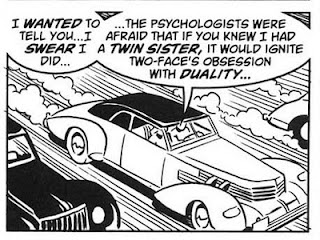
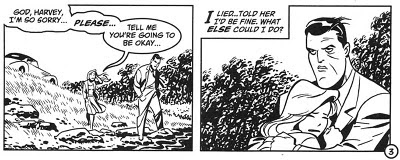
Anywho, in this eight page story written and drawn by Bruce Timm, Two-Face gets some state-of-the-art plastic surgery and therapy to get rid of the Two-Face persona, compliments of Bruce Wayne. He then falls in love with Marilyn, the beautiful and brilliant lady plastic surgeon who fixed him up.

Everybody's all happy. Harvey's wearing a hat. The happy couple is out shopping for wedding rings. It's all a little slice of heaven until...

...Marilyn's twin sister shows up.

*For all you kiddies who are too young to remember, Ralph Bellamy was a classic movie actor from the 30's and 40's. He always played a boob, usually the dumb ex-boyfriend to the the smart, sassy heroine of the picture. Here he is:

If you are a Two-Face fan, even a small one, then you are in for a treat. Thankfully, it's easy to come by, so there's no excuse not to hunt it down and read it.
Let me start off by saying that I never really cared much for the Bruce Timm-created Batman: The Animated Series version of Two-Face. He was portrayed a bit too much like a stereotyped 1930's gangster. Plus, I didn't like the look at all. The bad side of his face was blue (maybe not to scare the kiddies?) and a tad too ridiculous, and the good side of his face looked wayyy to much like Ralph Bellamy for my tastes.* (Though I'm pretty sure Timm went on record saying he used another classic actor as inspiration, but the name escapes me right now.)
Anywho, in this eight page story written and drawn by Bruce Timm, Two-Face gets some state-of-the-art plastic surgery and therapy to get rid of the Two-Face persona, compliments of Bruce Wayne. He then falls in love with Marilyn, the beautiful and brilliant lady plastic surgeon who fixed him up.

Harvey Dent in a hat. You got into my dreams again, didn't you, Mr. Timm?
Everybody's all happy. Harvey's wearing a hat. The happy couple is out shopping for wedding rings. It's all a little slice of heaven until...

...Marilyn's twin sister shows up.

A leopard print jacket? This girl's got style!
And we all know how Harvey Dent has some issues with the number two.

I will say this about Bruce Timm: he draws a hell of a classic car. I guess crime does pay. In the form of a 1937 Supercharged Cord 812. (Originally I had "Packards," but Bubbashelby was nice enough to identify the model of the car for me!)
I'm not going to give away the ending, but suffice to say, it's a darn good one, and it has a bit of a twist. The amazing thing part of it all is that Bruce Timm is able to pull off a story a beginning, middle, and an end, a clear sense of tone and voice, and a dramatic punch of a finish, to boot, all in just eight pages. The sad thing is that I read this very early on in new comics reading days, so was under the impression that all comics were this good.

It's a sad, tough, cynical world, Marilyn.
I can't recommend this story highly enough. It ranks up there with the best of the best Two-Face stories, and Timm does in eight pages what very few writers can do in 22 pages, or 202 pages for that matter.
*For all you kiddies who are too young to remember, Ralph Bellamy was a classic movie actor from the 30's and 40's. He always played a boob, usually the dumb ex-boyfriend to the the smart, sassy heroine of the picture. Here he is:
He's not a bad guy nor a bad actor. But he was always the butt of everyone's joke.
Sunday, August 29, 2010
75 Favorite Moments in DC History: Number 55
55. Two-Face gets a cupcake. (Yes, you read that right.) (Detective Comics #747, 2000, collected in Gotham Central Volume 2, "Half a Life," 2005 and New Gotham: Volume 1, 2001)
"Character may be manifested in the great moments, but it is made in the small ones," said Phillips Brooks, a guy who I don't know from Adam but just found a quote from through a quick Google search.
Face it, comic books are about BIG moments. Planets blowing up and things being thrown into the sun and all that. And while that's fine and good, it's a lot easier to relate to the smaller things in life.
The single-issue story in Detective Comics #747 is all about a day in the life of Gotham police detective Renee Montoya, specifically, her twenty-ninth birthday. A small mystery crops up when an unsigned bouquet of flowers arrives on her desk.
Amidst the day-to-day tasks of a detective, like testifying in court and putting up with obnoxious partners, Detective Montoya goes about solving the mystery of the unsigned flowers and finds out it was none other than Bruce Wayne who sent her the flowers.
Or was it?
Since this takes place right after No Man's Land, during which Montoya caught the eye of Harvey Dent and/or Two-Face (you're left guessing which side (or both) is enamoured with her. Though the truth is revealed in Rucka's No Man's Land novelization), Montoya surmises Bruce Wayne did sent the flowers on behalf of Dent.

This is the Batman I like: the one who still believes in redemption, who has a heart, who would do a favor for an old friend, which to me is much more heroic than just running around beating the stuffing out of criminals proclaiming you are the night. It's also the same Batman that was on the animated series back in the early 90's.
So, Montoya decides (grudgingly) to go visit Harvey:

And, Batman leaves one of his friendly neighborhood Batman notes in Renee's car:

"Character may be manifested in the great moments, but it is made in the small ones," said Phillips Brooks, a guy who I don't know from Adam but just found a quote from through a quick Google search.
Face it, comic books are about BIG moments. Planets blowing up and things being thrown into the sun and all that. And while that's fine and good, it's a lot easier to relate to the smaller things in life.
The single-issue story in Detective Comics #747 is all about a day in the life of Gotham police detective Renee Montoya, specifically, her twenty-ninth birthday. A small mystery crops up when an unsigned bouquet of flowers arrives on her desk.
Amidst the day-to-day tasks of a detective, like testifying in court and putting up with obnoxious partners, Detective Montoya goes about solving the mystery of the unsigned flowers and finds out it was none other than Bruce Wayne who sent her the flowers.
Or was it?
Since this takes place right after No Man's Land, during which Montoya caught the eye of Harvey Dent and/or Two-Face (you're left guessing which side (or both) is enamoured with her. Though the truth is revealed in Rucka's No Man's Land novelization), Montoya surmises Bruce Wayne did sent the flowers on behalf of Dent.

This is the Batman I like: the one who still believes in redemption, who has a heart, who would do a favor for an old friend, which to me is much more heroic than just running around beating the stuffing out of criminals proclaiming you are the night. It's also the same Batman that was on the animated series back in the early 90's.
So, Montoya decides (grudgingly) to go visit Harvey:

Dammit, Dent! I said off the phone already!

See? Even Batman knows villains need to be loved.
Oh, and the type of flowers Two-Face sent Montoya? Tulips. Do you know how many times I read this story and STILL didn't figure out why it should be tulips? I also just realized now that the color scheme throughout this issue is made up of only two colors. I may not be the sharpest tack in the tool shed, but hey, that doesn't stop me from trying.
Saturday, August 28, 2010
Clothes Make the Man. (Or Villain.)
Quick: think of three memorably-dressed villains who wear a suit. Got them in mind? Good. I'll bet you a dollar that Two-Face is on your list.
Anyone read last week's Batman: Streets of Gotham? If you didn't, who is this guy?:

C'mon, DC! Have you no shame? Putting Two-Face--a character with a wardrobe so iconic it's probably only second to the Joker--in a hoodie? What exactly are you trying to communicate to the reader with a sweatshirt? That the cost of dry cleaning really has gone up in recent months?
I guess I'm either a very visual person, or just a very superficial one, because I get hung up a lot on a character's appearance. (I call it "design" and that make me feel better about myself.) Maybe I'm wrong, but I put a lot of stock into a character's appearance, and I think a character's looks, and what a character chooses to wear (or not to wear), are a crucial point of reference to who the character is. It's a visual medium, so I guess I'm allowed to be superficially judgmental. Taking away the iconic two-tone suit is like taking away Two-Face's coin. It's a part of who he is. Just like giving Booster Gold a buzz cut was wrong. He's a dandy. He has to have ridiculously elaborate, never-out-of-place hair that takes hours to style because that's the kind of guy he is. It says something about him. Likewise, Two-Face needs to spend ridiculous amounts of time with two different colored suits, a seam ripper, and a sewing machine on a regular basis.
Sure, he can wear a hoodie if he wants to. For a scene or two. But for the whole book? Nope.
I wasn't the only one who picked up on it, because a (positive) review of the issue at Panels on Pages mentioned it, too:
Gone is the dichotomy inspired wardrobe and villain lairs and in their place we have Harvey Dent in a hooded sweatshirt hiding out in a subway car full of silent, terrorized Gothamites.They also mention the writing as "solid." I wouldn't go that far. It's not bad, but it's rather un-ambitious and shallow, just going through the motions. It's too bad the writers eschewed Dent's point-of-view and internal motivations all together and instead took on an objective third person narration. I like to see inside a villain's mind. Maybe if they had done that, I'd know why he decided to wear that silly sweatshirt.
Tuesday, August 24, 2010
75 Favorite Moments in DC History: Number 58
58. Harvey Dent argues against Two-Face (Detective Comics #739, collected in Batman: No Man's Land, 1999).
Well, it's no secret that I'm a big sucker for a Two-Face appearance, no matter how small. The gigantic Batman crossover No Man's Land featured Two-Face quite prominently. He was still being characterized as a gangster with split personalities ("dissociative identity disorder" being the proper term for it nowadays), which, as I'm reading more comics, I'm starting to like less and less. (It's Scipio's fault, really.)
Anyway, the lawlessness of No Man's Land provided the perfect opportunity for Two-Face to set up his very own courtroom, which never ceases to amuse me. Frankly, I think the writers could've milked this a little more for what it's worth (perhaps they did in the issues that weren't collected in the trades.) But what I think makes Two-Face the "scariest" (when written correctly) villain is, that, like Batman, he believes in justice, albeit a darker shade of justice. Vigilante heroes, by definition, operate outside the law to administer justice when the legitimate justice system can't. Why should Harvey Dent's version of vigilante justice be any less legitimate than Batman's?
Well, that's a topic to be explored for another day. But, back to No Man's Land. Basically, Harvey's little courtroom involved putting Jim Gordon on trial. Two-Face was the prosecution, and Harvey Dent, after Renee Montoya's pleading, became the defense, and both sides of his personality argue against each other. (Which I find a bit of a stretch. I mean, a D.A. playing defense attorney?)
Here you go:

It is a bit over-the-top, but, hey, it's Gotham, so what do you expect?
Well, it's no secret that I'm a big sucker for a Two-Face appearance, no matter how small. The gigantic Batman crossover No Man's Land featured Two-Face quite prominently. He was still being characterized as a gangster with split personalities ("dissociative identity disorder" being the proper term for it nowadays), which, as I'm reading more comics, I'm starting to like less and less. (It's Scipio's fault, really.)
Anyway, the lawlessness of No Man's Land provided the perfect opportunity for Two-Face to set up his very own courtroom, which never ceases to amuse me. Frankly, I think the writers could've milked this a little more for what it's worth (perhaps they did in the issues that weren't collected in the trades.) But what I think makes Two-Face the "scariest" (when written correctly) villain is, that, like Batman, he believes in justice, albeit a darker shade of justice. Vigilante heroes, by definition, operate outside the law to administer justice when the legitimate justice system can't. Why should Harvey Dent's version of vigilante justice be any less legitimate than Batman's?
Well, that's a topic to be explored for another day. But, back to No Man's Land. Basically, Harvey's little courtroom involved putting Jim Gordon on trial. Two-Face was the prosecution, and Harvey Dent, after Renee Montoya's pleading, became the defense, and both sides of his personality argue against each other. (Which I find a bit of a stretch. I mean, a D.A. playing defense attorney?)
Here you go:

They never tell you who the stenographer is...
It is a bit over-the-top, but, hey, it's Gotham, so what do you expect?
Wednesday, August 4, 2010
75 Favorite Moments in DC History: Number 74
74. Harvey Dent gets things done his way (Batman: The Long Halloween, 1997).
The Long Halloween was the first graphic novel I ever read, so I kind of have a soft spot for it in my heart. I know a lot of people aren't Jeph Loeb fans, but I rank this graphic novel as one of my favorites, and I really think Loeb gots things right with The Long Halloween. Why? Because not only is it a definitive retelling of Two-Face's fall-from-grace origin, but it showed how Harvey Dent is perhaps the most threatening of Batman villains: Harvey Dent is a scary, scary man, but not because he kills without abandon like the Joker, but because he believes in justice, just like Batman and Gordon and all the other good guys do. The scary part is that he has no reservations about crossing the line to mete out justice, even if this means killing two men in cold blood. Basically, in this incarnation, Harvey is like Batman without his "one rule" against killing, and if Harvey Dent protected Gotham instead, there'd be no criminals escaping every other month from Arkham to go off on killing sprees like they do under Batman's watch. The even scarier part is when you realize that perhaps Harvey's way of doing things might actually be better. For what's the point of having a justice system if it's corrupted, or a police force that can't protect its citizens, or an oath against killing if it only results in more death?
Here's that moment, and Harvey's reasoning:

Now can you understand why I was so excited at the possibility of a Harvey Dent Batman?
The Long Halloween was the first graphic novel I ever read, so I kind of have a soft spot for it in my heart. I know a lot of people aren't Jeph Loeb fans, but I rank this graphic novel as one of my favorites, and I really think Loeb gots things right with The Long Halloween. Why? Because not only is it a definitive retelling of Two-Face's fall-from-grace origin, but it showed how Harvey Dent is perhaps the most threatening of Batman villains: Harvey Dent is a scary, scary man, but not because he kills without abandon like the Joker, but because he believes in justice, just like Batman and Gordon and all the other good guys do. The scary part is that he has no reservations about crossing the line to mete out justice, even if this means killing two men in cold blood. Basically, in this incarnation, Harvey is like Batman without his "one rule" against killing, and if Harvey Dent protected Gotham instead, there'd be no criminals escaping every other month from Arkham to go off on killing sprees like they do under Batman's watch. The even scarier part is when you realize that perhaps Harvey's way of doing things might actually be better. For what's the point of having a justice system if it's corrupted, or a police force that can't protect its citizens, or an oath against killing if it only results in more death?
Here's that moment, and Harvey's reasoning:

Click to enlarge.
Now can you understand why I was so excited at the possibility of a Harvey Dent Batman?
Subscribe to:
Posts (Atom)